



Our last SLMP Memo, released towards the end of March 2026, was written at a time when investor sentiment was dominated by uncertainty. Tariffs, the onset of the Middle East conflict, a sharp rise in crude oil prices and growing concerns around AI and its potential impact on India, had created a long list of reasons for investors to remain cautious. Yet, we argued that while the near-term risks were real, we believed the underlying drivers of the Indian economy and markets remained largely structural and long term. As we wrote then:
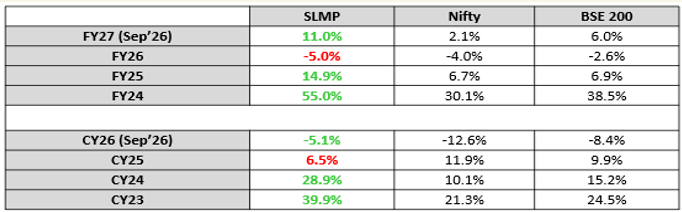
SLMP has subsequently delivered returns of 11% over the last 6 months, despite continued volatility in crude oil prices, tariff-related uncertainty, concerns around AI and the ongoing conflict in the Middle East, with no clear resolution in sight. September was another weak month for the markets, as these uncertainties resurfaced. The Nifty 50 and several individual stocks have retraced to levels last seen in March 2026, creating what we believe are compelling long-term investment opportunities for investors willing to withstand near-term volatility.
Our growing bullishness, despite weak market sentiment and subdued portfolio returns, is driven by two key factors: an improving earnings growth outlook and attractive valuations across large-cap stocks. We believe the combination of these factors provides a favorable setup for the medium to long term.
SLMP performance
Our objective of generating 3–5% alpha over the Nifty on a post-fees basis is currently being exceeded while we remain quite close to our aspiration of returns of 16-18% post fees over a 4-5 years period.
Net Returns of SLMP vs Benchmarks (as of 30th September, 2026) *
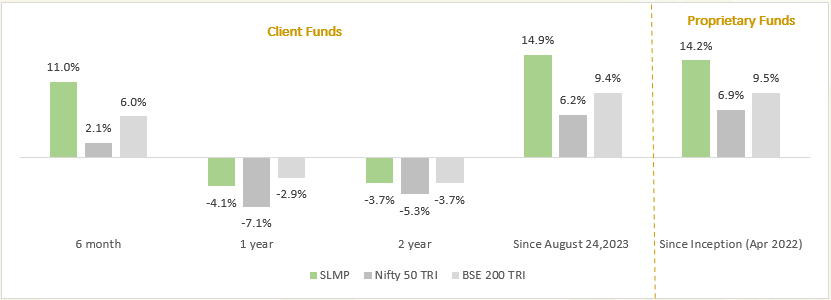
*Returns are net of costs and fees and a combination of managing proprietary funds from 1st April 2022 up to 24th August 2023, followed by managing client money. Returns greater than 12 months are annualized returns. BSE 200 TRI is assumed as BSE 200 returns plus dividend yield of 1.8% p.a.
Note: Returns of individual clients will differ from the above numbers based on the timing of their investments. Past performance is not an indication or promise of future performance. The performance related data has not been verified by SEBI.
Low recent absolute returns in Large Caps provides great long-term opportunity
Recent absolute performance has been impacted by the underperformance of large caps versus mid and small caps, as illustrated below. The divergence has been particularly sharp over the last year as seen in the chart.
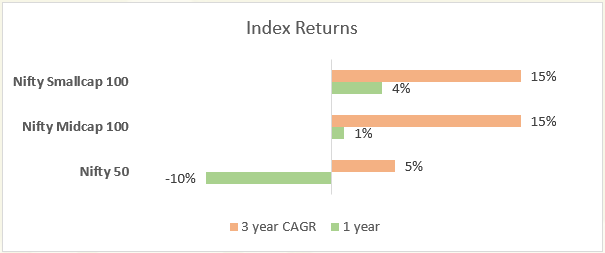
We believe large-cap underperformance can broadly be attributed to a combination of two factors:
- a) Long-term growth reset in certain sectors such as IT – due to AI-related concerns, FMCG – due to the rise of quick commerce and D2C brands; resulting in significant valuation de-rating.
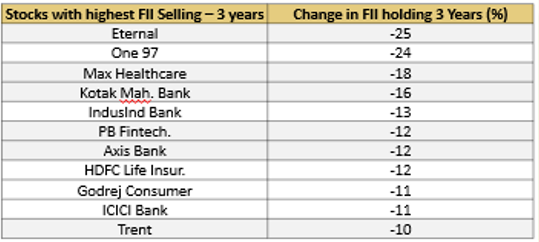
b) Persistent FII selling: Several large caps, have faced sustained FII selling (FIIs majorly participate in large cap stocks due to higher liquidity). In some cases, FII ownership has fallen by more than 10% of total shareholding. The resulting increase in supply, has contributed to significant PE de-rating.
Below are the companies that have witnessed the maximum large cap selling over the last 3 years.
The prolonged underperformance of large-cap stocks has tested investor patience, with even large-cap mutual funds witnessing outflows. However, investors must remember that equity returns are inherently non-linear, and performance should be evaluated over longer periods rather than any single one- or two-year period. An asset class delivering low or negative returns over two years does not necessarily imply a similar experience over the next two years.
Periods of underperformance are precisely when investors need to look beyond recent returns and examine the underlying drivers of stock prices. Two of the most important drivers of market returns are earnings and valuations, and both are currently moving in a more favorable direction.
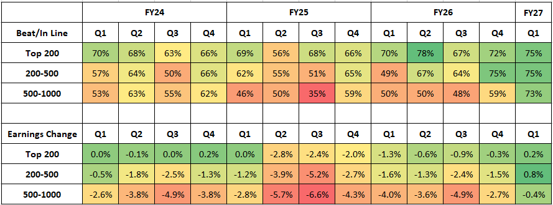
On earnings, the improvement is encouraging, although a sustained market move will depend on this momentum continuing. Our proprietary data tracks quarterly earnings beats/misses and upgrades/downgrades across three market-cap buckets — Top 200, 200–500 and 500–1,000 stocks. The earnings downgrade cycle that began in FY25, appears to have ended over the last two quarters. While some recent upgrades could be partly driven by inventory gains, the next two quarters should provide greater clarity. Nevertheless, earnings have held up better than expected despite war-related disruptions, while the significant cuts seen over several quarters have also helped moderate expectations.
On valuations, our investment universe of Top 200 stocks (by market cap) has also seen a big de-rating over the last 2 years and is now close to the 10-year averages in terms of valuation multiples.

However, a further split of the Top 200 stocks into the Top 100 (large-cap stocks) and the next 100 (mid-cap stocks), based on AMFI’s market-cap classification, reveals a stark difference in valuations. Large-cap stocks are now trading below their 10-year average valuations and at materially lower multiples than two years ago. In contrast, while the next 100 stocks by market capitalisation have also become cheaper relative to two years ago, their valuations remain above their 10-year average. This distinction is particularly relevant for SLMP, with ~65% of the portfolio allocated to large-cap stocks. Return of FIIs could give a further leg up.

Stock pickers market
Currently the market has 2 types of companies – a) those delivering strong earnings growth are being rewarded with multiple expansion, making many of these stocks increasingly expensive and b) those reporting disappointing earnings and facing valuation de-rating, making them significantly cheaper.
Both ends of this spectrum carry risks. Expensive stocks may struggle to deliver further returns if earnings growth fails to justify their valuations, while seemingly cheap stocks may turn out to be value traps if their earnings fail to recover thus becoming a stock picker’s market. Success will depend on building a balanced portfolio with strong earnings momentum as well as those offering attractive valuations and the potential for an earnings recovery. This requires in-depth fundamental research to distinguish sustainable growth from momentum-driven optimism and genuine value opportunities from businesses facing structural challenges.
SLMP is a differentiated product in the large cap space
As this is a stock pickers market, concentrated portfolios like SLMP will have a more meaningful role to play. SLMP is a bottoms up concentrated portfolio with the core focus on generating an alpha to large cap indieces and large cap mutual funds.
No Large Cap fund has outperformed SLMP over three years. A few Large & Midcap funds have generated higher alpha, but are structurally different with only ~40% Large Cap exposure and ~17% Small Cap exposure, versus ~65% Large Cap and 0% Small Cap exposure for SLMP. SLMP occupies a differentiated position: targeting returns at the upper end of the Large & Midcap category, without taking any Small Cap exposure.


SLMP’s performance could have been significantly better, baring a blip
FY26/CY25 was the only period where performance was meaningfully weaker, and this was largely driven by a three-month period from November 2025 to January 2026, when SLMP declined ~10% versus slightly negative index returns. In hindsight, we entered certain stocks at the wrong prices and made some stock-selection mistakes. Importantly, these mistakes were concentrated in this short period rather than being a recurring feature of the portfolio. This is also evident from the contribution analysis: the three largest detractors over the three-year period are the same three stocks that were the largest detractors over the last one-year period, indicating that the bulk of the underperformance came from this specific period. While mistakes are an inevitable part of investing, we believe the broader track record — both over the longer term and across the periods outside these three months — remains very strong.

Portfolio earnings growth remains robust
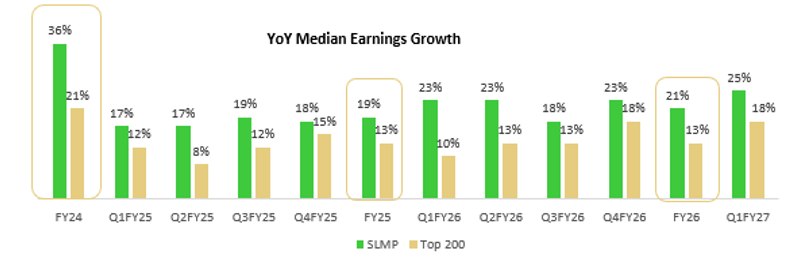
Our primary focus continues to be the underlying earnings growth of the companies we own, and on this metric the portfolio remains strong. Importantly, the earnings growth of our portfolio companies continues to exceed that of our fishing pond — the top 200 listed companies — and this trend has remained consistent across multiple quarters.
SLMP median earnings growth over the next 2 years for the portfolio is expected to be 25% CAGR.
Portfolio earnings have started seeing upgrades recently
Earnings revisions for the SLMP portfolio have remained relatively resilient. After the strong growth seen in FY24, the portfolio experienced meaningful earnings cuts through FY25, while revisions stabilized during FY26. More recently, however, earnings estimates have started moving up again. Importantly, the earnings upgrades have not been accompanied by a commensurate increase in stock prices across the portfolio. This suggests that valuations in several holdings remain reasonable despite the improving earnings outlook

Portfolio realignment
We have had higher-than-usual churn to the SLMP portfolio over the past year to improve its positioning for future growth. We have also consolidated the portfolio at 22 stocks versus 25 stocks earlier. We continue to make necessary changes and weight adjustments in our portfolio, in our quest to position the portfolio optimally on fundamentals & valuations. We do not expect churn to remain at these elevated levels.
With the portfolio now better positioned for growth, earnings revisions turning positive and valuations providing reasonable comfort, we remain constructive on the outlook for SLMP going forward. Some of the new additions in the SLMP portfolio have been platform companies, which now have a significant weight in the portfolio.
Higher allocation in to platform businesses in our portfolio
Currently, ~20% of SLMP is invested across four platform companies spanning food delivery, quick commerce, e-commerce, insurance and financial services. The 20% contribution of platforms is a significant increase over the last year. Notably, our two largest portfolio holdings are platform businesses, reflecting our conviction in the long-term opportunity.
A platform company is a technology-enabled business that connects buyers and sellers and can scale with relatively low incremental costs. This creates the potential for disproportionate revenue and profit growth, making platforms some of the fastest-growing businesses in the large-cap universe. The US provides several examples — Alphabet, Microsoft, Meta and Amazon have grown into some of the world’s largest companies while continuing to deliver strong growth of 15% despite their enormous revenue bases of USD 200-300 bn.
For example:
- Airbnb has a larger market capitalization than Marriott despite owning virtually no hotels
- Uber has a market capitalization equivalent to a significant portion of Toyota despite not owning the cars that provide its service.
- Blinkit, launched only around five years ago, is approaching the revenue scale of DMart, a business that began in 2006 and is regarded as one of India’s most efficient retailers.
We have written two detailed notes on platform businesses previously explaining this section in detail:
Platforms Note 1 – 2022 and Platforms Note 2 – 2026
The key attraction is operating leverage. Technology and employee costs are often incurred upfront, while incremental revenue can be added without a proportionate increase in costs or the asset base. As scale increases, this can result in a significant expansion in margins, profits and ultimately ROE and free cash flow.
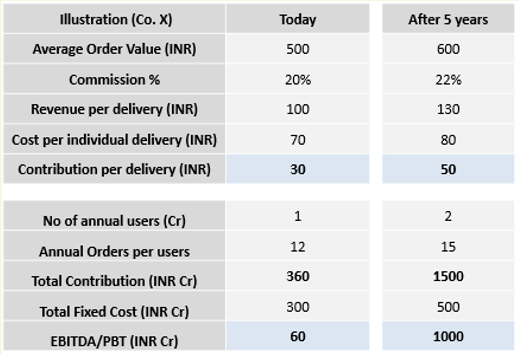
We are constructive on platform businesses with strong market share, a meaningful share of the profit pool and clear visibility of improving profitability and free cash flow. While such companies can appear expensive on current earnings, their large TAM, operating leverage and high incremental ROE can support strong compounding over several years.
Conclusion
To conclude, we have a positive outlook on both the market and the current SLMP constituents and we do believe that for investors with patience and a long-term horizon, this environment continues to offer an attractive opportunity to increase equity exposure. We remain constructive on the market and would advocate using volatility to one’s advantage—either by being more aggressive during sharp corrections or by consistently adding on dips.
Many investors are understandably losing patience after experiencing weak or negative returns over a two-year period, despite SLMP delivering a three-year CAGR of approximately 15%. While our endeavour remains to generate meaningful absolute returns for our investors, there will inevitably be periods when doing so becomes challenging.
Investing in equities requires patience and discipline, as returns are rarely linear or evenly distributed over time. While shorter periods can be disappointing, the long-term wealth creation potential of equities remains meaningful for investors who stay invested in fundamentally sound businesses and allow their earnings to compound. Our focus remains on making sound investment decisions, learning from our mistakes and delivering robust returns over the long term as we believe this is a stock pickers market.
24 months of time and price correction have led to more reasonable valuations, implying lower risk. While near-term disruptions—particularly from potential escalation in geopolitical tensions and oil-related supply shocks—could impact markets over the next quarter or two, these are largely cyclical in nature.
This memo marks three years since we started managing client money in SLMP and 4.5 years since we conceptualized SLMP with proprietary money. We have stuck through our process even during testing times as we have a lot of confidence in the same as this is critical for generating long-term alpha. We continue to aspire for 16–18% annualized returns over a 4–5-year horizon (post fees) and believe this remains achievable.
Thank you for always having faith in SageOne and we hope that we continue to deliver to our clients through this offering and look forward to your participation.
Warm Regards,
Satish Kothari & Kshitij Kaji
Fund Managers, SLMP
SageOne Investment Managers LLP
Legal Information and Disclosures
Any performance related information provided above is not verified by SEBI.
This note expresses the views of the author as of the date indicated and such views are subject to changes without notice. SageOne has no duty or obligation to update the information contained herein. Further, SageOne makes no representation, and it should not be assumed, that past performance is an indication of future results.
This note is for educational purposes only and should not be used for any other purpose. The information contained herein does not constitute and should not be construed as an offering of advisory services or financial products. Certain information contained herein concerning economic/corporate trends and performance is based on or derived from independent third-party sources. SageOne believes that the sources from which such information has been obtained are reliable; however, it cannot guarantee the accuracy of such information or the assumptions on which such information is based.